
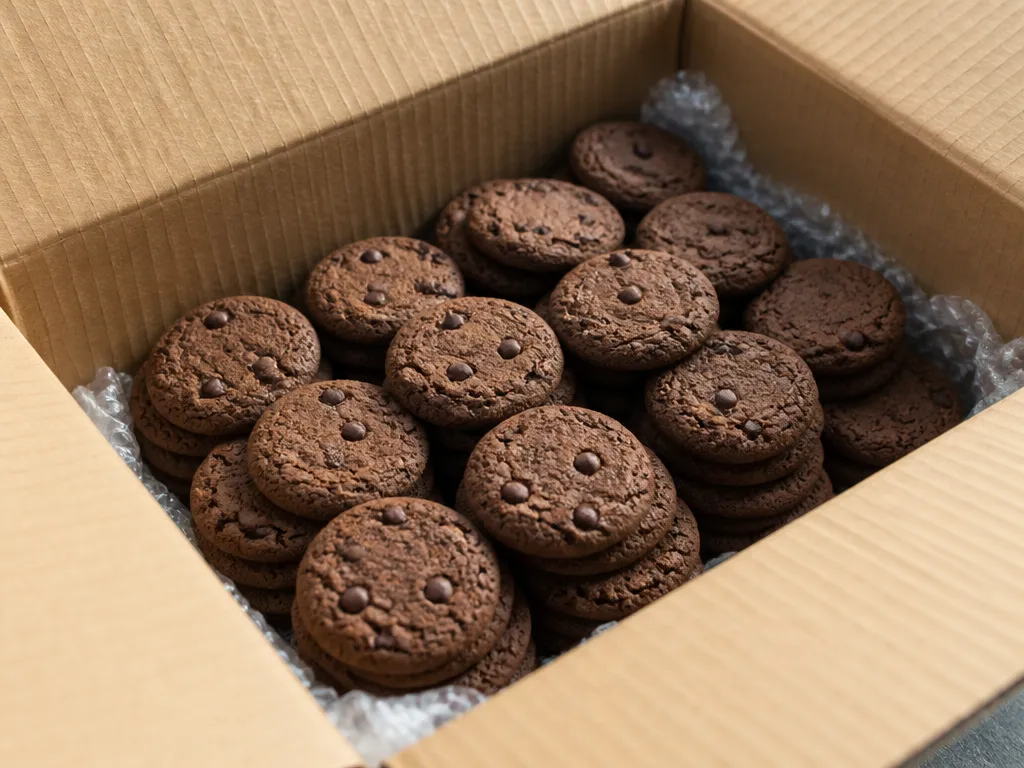
Chocolate cookies start softening fast once temperatures climb above 75°F and milk chocolate can fully melt around 88-90°F. The easiest way to prevent a sad, smudged delivery is to treat this like a small cold-chain job: insulate the box, actively chill the interior air, and ship on the right days. This guide shows exactly how to pack cookies so they arrive intact, with practical thresholds and a repeatable packing workflow.
Chocolate cookies melt when the shipment interior crosses about 88-90°F, and they start softening around 75°F. To keep them safe, use an insulated liner plus at least 2 gel ice packs, and keep transit under 3 days (often under 2 days in warmer weather). Ship early in the week (Monday-Wednesday) to avoid weekend heat exposure.
Key Takeaways
- Chocolate softens at 75°F. Keeping the box below that slows damage dramatically.
- Milk chocolate’s melting range is 88-90°F. Expose chocolate to those temperatures for more than 2 hours and quality suffers.
- Insulation is mandatory. Use an insulated liner (foil-backed foam or EPS foam cooler).
- Use at least 2 gel packs. More heat exposure needs more “active” cooling inside the box.
- Transit time matters most. Keep delivery under 3 days, and use faster services when it is hot.
- Ship Monday-Wednesday. Packages sent late in the week risk sitting in hot facilities over the weekend.
How to Ship Chocolate Cookies Without Melting
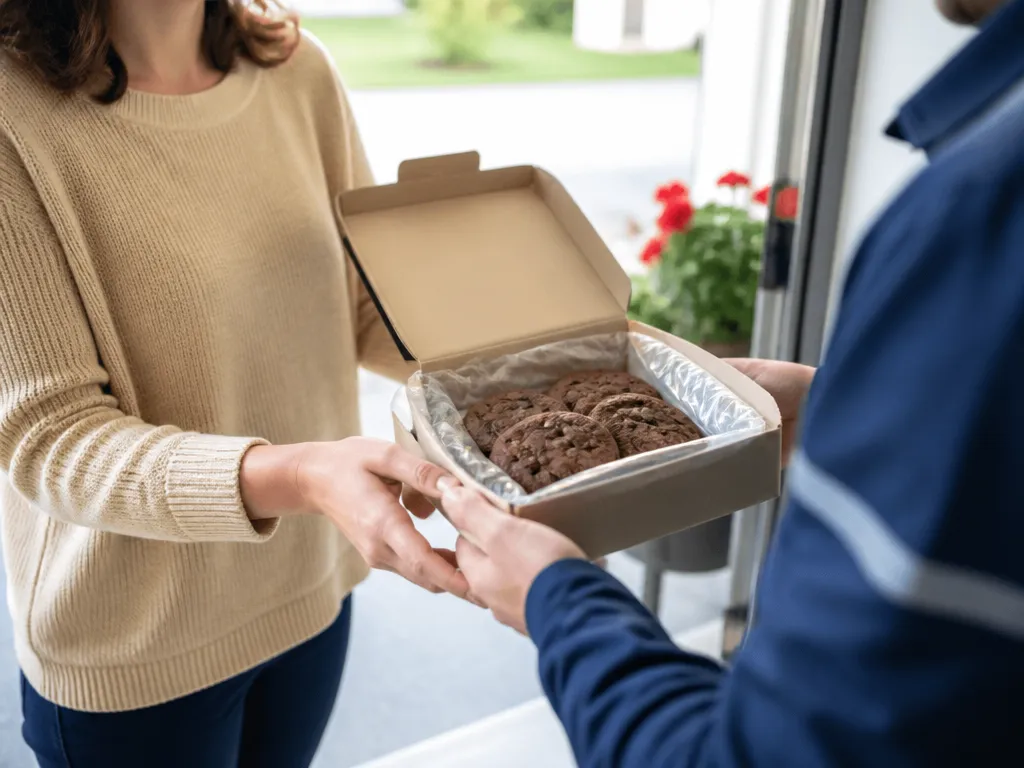
Chocolate cookies aren’t like boxed fudge where everything is liquid. Chocolate chips, drizzle, or a cookie top can start to soften and lose texture well before you see a full melt. If you ship in warm weather without insulation and gel packs, you are gambling that a truck and a doorstep will stay under the chocolate’s critical temperatures.
Your win condition is simple: keep cookie surface temperature low enough for long enough that chips don’t go glossy and smear. That means you control three things at once: temperature (inside the box), packaging insulation, and timing (fast delivery, smart shipping days). If you only do one of those, the other two will still get you.
For example, I’ve seen cookies that looked fine at drop-off become tacky after a 3-day route during summer, even when they were in bubble wrap. The bubble wrap slows impact damage, it does not stop the temperature inside the box from climbing. Treat bubble wrap as protection against shifting, not as temperature control.
Do this checklist before you pack:
- Fully cool cookies before you seal them (warm cookies drive condensation and soften chocolate faster).
- Choose your carrier based on total transit time, not just the “label speed.”
- Build the box so gel packs are in the right spots and can pull heat down for the whole trip.
Choosing the Right Packaging for Cookies
The best packaging for chocolate cookies is rigid, cushioning, and airtight enough that cookies cannot slide around and melt-prone chocolate chips cannot rub together. For most home shippers, that means a sturdy outer box plus an internal container system that prevents movement.
Start with a rigid inner container (a tin or plastic container with a tight lid) if you’re shipping a small batch. Your goal is to create a stable “cookie raft” so chips and drizzle do not get broken by sudden impacts or corner-to-corner contact. Line the container with crinkle paper or bubble wrap and fill voids so nothing shifts.
If you are shipping more than a few dozen cookies, switching to compartmentalization helps. Individual wrapping works for delicate cookies, and parchment separators help stop sticking. One more thing that surprised me the first time I tried it: stacking without firm separators can lead to chocolate chips melting slightly, then re-setting into a different texture, and the surface won’t look right even if the cookies are technically “not melted.”
For carrier selection, speed and tracking matter because freshness declines as time stretches. The practical rule is simple: the longer the package is in transit, the more opportunity you have for warm interior temperatures to creep up. Aim to ship with the fastest service you can reasonably afford, then protect the box so the temperature inside stays stable.
How to Pack Cookies for Mailing Without Damage
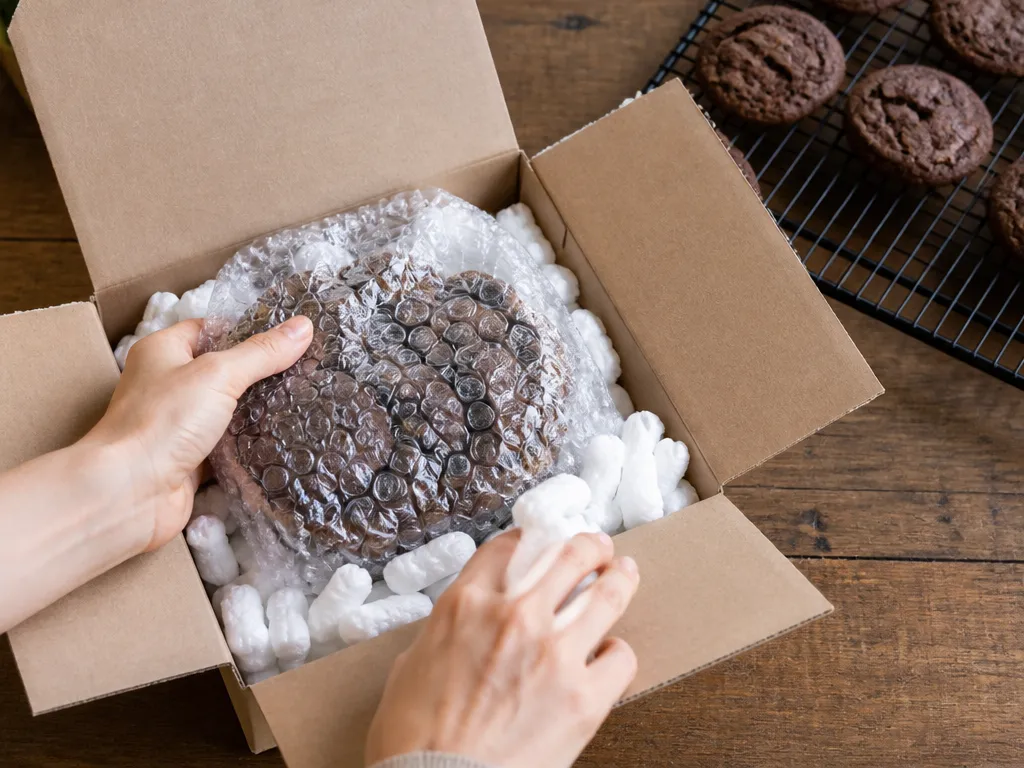
Packing is half logistics and half physics. The physics part is that cookies move in transit unless you lock them in place; once they move, they break, smear, and pick up heat from contact with warmer spots in the box.
Use this approach for cookie stability:
- Cool completely. Warm cookies trap moisture inside the container, which can soften chocolate during transport.
- Layer with separators. Use parchment or crinkle to stop cookies from grinding against each other.
- Containerize. Put cookies in a rigid, airtight tin or plastic container so they cannot shift.
- Cushion voids. Line the container and fill empty spaces so the cookies stay fixed even if the box jolts.
- Double-bag if needed. If you are using gel packs inside an insulated box, keep condensation away from cookies by sealing the cookie container in a way that prevents drips.
A shipping box that only has “padding” is still a temperature problem. Padding prevents impact damage, but it does not guarantee the cookie surface stays below the chocolate’s softening point. That is why temperature control materials belong in the packing system, not as an afterthought.
Here are cookie types that tend to survive better because their structure is stable. This matters because “melting” is not always the only failure mode; crumbling and softness can be packing-related too.
| Type of Cookie | Does it ship well? | Why it usually survives | Tip for shipping |
|---|---|---|---|
| Butter or shortbread cookies | Yes | Low moisture, sturdy crumb | Wrap and stack using parchment paper |
| Biscotti | Yes | Dry and rigid, long shelf life | Wrap with other pieces for stability |
| Bar-type cookies like brownies or blondies | Yes | Dense and stable | Wrap individually |
| Gingersnap or molasses cookies | Yes | Firm and stable edges | Pad edges and avoid overbaking to reduce brittleness |
| Oatmeal cookies | Usually | Chewy but stable | Chill before packing to firm up |
| Macarons | Tricky | Fragile shells and humidity sensitive | Use specialty trays and cold packs |
For chocolate cookies specifically, the main risk is that chocolate chips or toppings are heat-sensitive. So even if your cookie base is stable, the chocolate layer is the weak link. Pack for movement prevention and then add real temperature control.
How to Ship Chocolate Without Melting
To ship chocolate cookies without melting, you have to stay below key chocolate temperature thresholds while also limiting how long the box is exposed. Milk chocolate softens at 75°F, loses its temper at 82°F, and fully melts between 88-90°F. If the shipment is exposed to those temperatures for more than 2 hours, quality is compromised.
Pack like you’re protecting against real heat sources, not theoretical comfort. Delivery trucks and doorsteps get hot even when the air feels “okay” outside. Protect the inner container from movement and condensation, and account for the service level needed to get the package delivered quickly.
At What Temperature Does Chocolate Melt During Transit
Chocolate temperatures don’t need to hit “melting puddle” to damage quality. Chocolate softens at 75°F and loses temper at 82°F, which means the cocoa butter crystals can destabilize even if it never turns fully liquid. Once chocolate reaches that warm zone and then re-cools, it can look off and feel different.
Milk chocolate’s full melt range is 88-90°F (with chocolate types varying slightly). The practical guidance for shipping is that any shipment exposed to those critical temperatures for more than 2 hours will be compromised. That time window matters because it tells you why slow delivery and warm storage are such a problem.
Different chocolates melt and soften at different points, so your cookie topping type changes the risk profile. If your cookies use darker chocolate, milk chocolate, white chocolate, or compound coating, expect different thresholds:
| Chocolate Type | Softening Point | Loses Temper | Full Melt Point |
|---|---|---|---|
| Dark Chocolate | 78°F | 84°F | 90-93°F |
| Milk Chocolate | 75°F | 82°F | 88-90°F |
| White Chocolate | 73°F | 80°F | 85-88°F |
| Compound Coating | 80°F | 86°F | 92-95°F |
In practice, that means a “small” amount of milk or white chocolate on a cookie can be the limiting factor. Even if your cookie dough is fine, the chocolate topping is still trying to hit its softening curve. So you cannot treat chocolate cookies like generic cookies.
Insulation Options for Chocolate-Safe Shipping
Insulation is how you buy time. The best insulation options give the box thermal mass, so interior temperature doesn’t swing wildly when the outside air or the delivery truck heats up.
If you are shipping higher value or you expect longer routes, thick foam is the most protective route. Thick Styrofoam (about 1.5″-2″) can keep box temperatures stable for 24-36 hours even in summer conditions. That’s why it is commonly recommended for longer transit and higher stakes.
For smaller-to-mid volume shipping with 1-2 day delivery in moderate heat, foam insulated mailers (around 1″-1.5″ walls) are usually the practical middle ground. They are easier to work with than full Styrofoam boxes and still provide real heat buffering.
Reflective bubble insulation (Mylar) can help for mild temperature swings, but it lacks the thermal mass to handle sustained summer heat. Use it as a secondary layer inside a cardboard box, not as the main insulation.
Here’s a temperature-to-transit packaging guide you can use:
- If destination highs are below 70°F, 3-day standard shipping is fine.
- For 70-80°F, use 2-day transit recommended, or 3-day only with strong insulation.
- For 80-90°F, keep it to 2-day maximum, overnight preferred.
- For above 90°F, overnight only, or hold the order.
In other words, insulation helps, but it doesn’t let you ignore hot weather. If your destination is in the 90°F+ category, your packaging can only do so much before time becomes the deciding factor.
What to Do If Shipped Cookies Arrive Melted
If your cookies arrive melted, don’t just shrug and chalk it up to “bad luck.” The first move is to assess whether it’s a texture issue only or a food-safety issue.
Melted chocolate can look worse than it tastes. Re-solidified chocolate can show fat bloom (a white or grey streaky look) and a grainy texture after it warms and cools again. That is common when temperature control fails and the cocoa butter recrystallizes.
Food-safety wise, if the cookies have been exposed to extreme heat long enough to soften the entire product, treat that as a risk. When in doubt, don’t serve to children or anyone sensitive to food-borne illness. When you can, inspect the packaging for signs of prolonged warmth, condensation that soaked into paper, or any strong off smells.
If the recipient is okay with “cosmetic damage,” you can still salvage usage:
- Use cookies for crumbling into ice cream or yogurt (texture becomes an ingredient).
- Let them set fully, then re-package for local consumption only (do not re-ship).
- Photograph the condition and note shipping dates, weather, and carrier service for your next shipment iteration.
The most useful next step is process correction. Melted delivery nearly always means one of these failed:
- The shipment took too long.
- The box was not insulated enough.
- You didn’t use enough gel packs (or they were poorly placed).
- You shipped on a day that increased weekend storage risk.
If you want to prevent repeats, keep a simple “shipping log” for every batch: ship date, delivery speed, destination high temperature, packaging type, gel pack count, and whether the box felt warm on arrival.
FAQ On How To Ship Chocolate Cookies Without Melting
How fast do I need to ship chocolate cookies to prevent melting?
Keep transit under 3 days as your baseline, and use faster service in warm weather. Milk chocolate softens at 75°F and fully melts at 88-90°F. Also ship Monday through Wednesday so your package does not sit over the weekend in hot facilities.
What packaging materials work best for shipping cookies with chocolate chips?
Use a rigid outer box with an insulated liner, then stabilize the cookies inside a rigid container lined with padding. For small-to-mid shipments, foam insulated mailers can work for 1-2 day routes.
Do I really need gel ice packs if my shipping box is insulated?
Yes. Insulation slows heat gain, but gel ice packs help counter warming during truck or facility delays.
When should I ship chocolate cookies in the US to reduce risk?
Ship chocolate cookies early in the week, Monday through Wednesday, to avoid weekend heat exposure. Ground-style shipping is only generally safe for chocolate during cooler months, while May through September typically needs expedited 2-day or overnight service. Use destination highs (below 70°F vs 70-80°F vs 80-90°F) to choose speed.
What is the most common mistake when mailing chocolate cookies?
Relying on bubble wrap and cushioning without active temperature control. Bubble wrap prevents dents and shifting, but it does not keep the interior below the chocolate’s 75°F softening zone. Another common mistake is shipping late in the week, which increases the odds the box waits in hot storage before delivery.
Disclosure: As an Amazon Associate, I may earn from qualifying purchases at no extra cost to you. Amazon and the Amazon logo are trademarks of Amazon.com, Inc, or its affiliates.
