
You have your sourdough starter ready, your dough has finished proofing, and you are looking forward to pulling a beautiful homemade loaf out of the oven. But there is one question that can make the process confusing: what size Dutch oven for sourdough should you actually buy?
Choose a pot that is too small, and your dough may press against the sides before it has room to expand. Choose one that is much larger than necessary, and you may end up handling extra-heavy cookware without gaining much practical benefit.
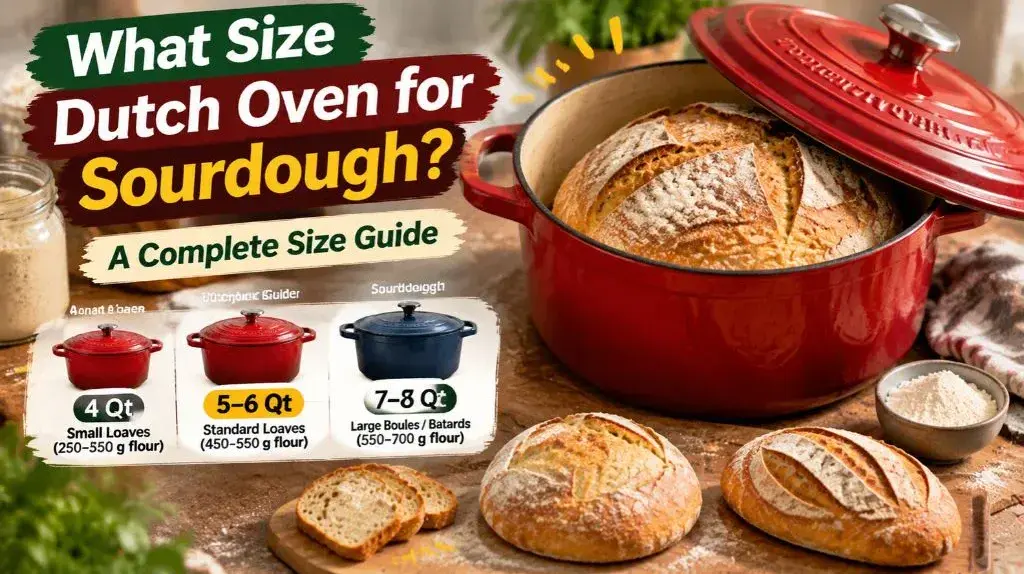
For most home bakers making a standard sourdough loaf with approximately 500 grams of flour, a 5- to 6-quart round Dutch oven is an excellent starting point. It offers enough room for the dough to expand while creating the covered baking environment needed for a good crust.
However, the right size depends on more than the number of quarts printed on the product label. Your dough weight, loaf shape, hydration, and the pot’s interior dimensions all matter.
In this guide, we will break down the different Dutch oven sizes, explain what works for common sourdough recipes, compare popular cookware options, and help you choose a pot that fits your baking habits and budget.
What Size Dutch Oven for Sourdough?
A 5- to 6-quart round Dutch oven is a great choice for most standard homemade sourdough loaves.
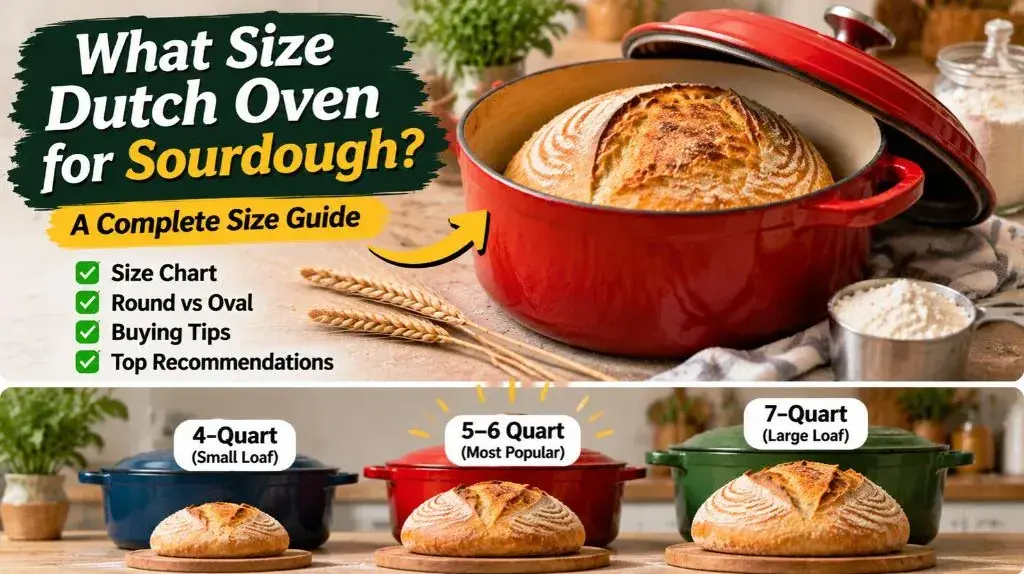
Here is a simple starting guide:
- 3–4 quarts: Small sourdough loaves.
- 4–5 quarts: Smaller standard loaves.
- 5–6 quarts: Most everyday sourdough boules.
- 6–7 quarts: Larger loaves and many oval batards.
- 7–8 quarts: Large loaves or bigger baking batches.
If you are buying your first Dutch oven mainly for sourdough, a 5.5- or 6-quart round model is a sensible all-around choice.
Why Does Dutch Oven Size Matter for Sourdough?
A Dutch oven does more than hold your bread while it bakes. It creates a small, enclosed baking environment that helps the loaf develop its shape, texture, and crust.
When sourdough dough enters a hot Dutch oven, the heat encourages rapid expansion during the early stage of baking. This is commonly called oven spring.
The dough also releases moisture as it heats. Because the lid traps much of that moisture, steam surrounds the loaf during the initial baking period.
This matters because steam delays the setting of the crust. It gives the dough more time to expand before the outer surface becomes firm.
Once the lid is removed, moisture can escape and the crust begins to dry, brown, and develop its final texture.
What Happens If the Dutch Oven Is Too Small?
A pot that is too small can restrict the loaf’s expansion.
If the dough touches the sides or lid during baking, the affected areas may develop an uneven shape or crust.
You may also find it difficult to transfer the dough safely into a hot pot, especially when working with high-hydration sourdough.
What Happens If the Dutch Oven Is Too Large?
A larger Dutch oven is not automatically a problem. You can bake good sourdough in a 7-quart pot even if your recipe does not fill the entire cooking space.
However, a much larger pot can be heavier, take longer to preheat, and offer little practical advantage when you are baking one standard loaf.
For most home bakers, matching the pot to the usual loaf size is more useful than simply buying the largest option available.
Dutch Oven Size Chart for Sourdough Bread
The following chart provides a practical starting point for choosing a Dutch oven based on the amount of flour in your recipe.
| Dutch Oven Size | Approximate Flour Weight | Best For |
|---|---|---|
| 3–4 quarts | 250–350 g | Small sourdough boules |
| 4–5 quarts | 350–450 g | Smaller everyday loaves |
| 5–6 quarts | 450–550 g | Standard sourdough boules |
| 6–7 quarts | 550–700 g | Larger boules and oval loaves |
| 7–8 quarts | 700–900 g | Large sourdough loaves |
These are approximate recommendations, not strict capacity limits. The actual dough weight will be higher than the flour weight because the recipe also contains water, starter, and salt. Pot shape, interior dimensions, hydration, and shaping can change the best fit.
What Size Dutch Oven Is Best for Different Sourdough Loaves?
Not every sourdough recipe produces the same kind of loaf. Some bakers prefer small round boules, while others make large family-sized loaves or longer batards.
Here is how to match the cookware to the type of bread you enjoy making.
1. Small Sourdough Boules: 3–4 Quarts
If you usually bake smaller sourdough loaves, a 3- to 4-quart Dutch oven may be enough.
This size is useful for smaller households, beginners experimenting with sourdough, or bakers who prefer making smaller batches more frequently.
However, check the interior width and height before purchasing. Some compact pots have enough capacity on paper but do not provide sufficient room for a rounded loaf to expand.
Buying tip: A compact Dutch oven is best when you consistently make smaller loaves. If you expect your recipes to grow, consider a larger size instead.
2. Standard Sourdough Boules: 5–6 Quarts
This is the most practical size range for many home sourdough bakers.
A standard recipe using around 500 grams of flour can produce a dough ball weighing close to 900–1,000 grams, depending on hydration and starter quantities.
A 5- to 6-quart round Dutch oven generally provides enough room for this type of loaf without being unnecessarily large.
It is also a versatile kitchen size. You can use the same pot to prepare soups, stews, braised meat, casseroles, and other meals.
If you only want to buy one Dutch oven for both bread baking and everyday cooking, this is where I would start.
3. Large Sourdough Boules: 6–7 Quarts
Do you prefer large loaves that last several days or serve a bigger household?
A 6- to 7-quart Dutch oven gives you additional room for larger dough batches.
This size can also be useful when working with dough that spreads more easily, although proper fermentation and shaping remain important.
Before buying, check the actual base diameter and lid clearance. A pot with a generous volume but a narrow base may not be ideal for a wide boule.
4. Oval Sourdough Batards: 6–7 Quarts
A batard is an elongated sourdough loaf rather than a round boule.
Because of its shape, an oval Dutch oven can be a better fit than a round one.
A 6- to 7-quart oval model is a useful starting point for many standard batards, but the interior length matters more than the advertised capacity alone.
Measure your shaped dough before purchasing and leave enough room for it to expand during baking.
Round vs Oval Dutch Oven: Which Is Better for Sourdough?
The shape of your Dutch oven can make a noticeable difference in how comfortably your dough fits.
| Feature | Round Dutch Oven | Oval Dutch Oven |
|---|---|---|
| Best loaf shape | Round boule | Long batard |
| Common size | 5–6 quarts | 6–7 quarts |
| Space efficiency | Excellent for round dough | Excellent for elongated dough |
| Everyday cooking | Very versatile | Useful for roasts and longer ingredients |
| Storage | Often easier | Requires more shelf space |
Why Choose a Round Dutch Oven?
A round Dutch oven is a natural fit for the classic sourdough boule.
Its shape makes it easier to position round dough in the center, and it is widely available in popular home-baking sizes.
It is also convenient for everyday recipes because many soups, stews, and casseroles are prepared in round pots.
Why Choose an Oval Dutch Oven?
If you regularly bake batards, an oval pot provides more length for the dough.
It can also be useful for preparing longer cuts of meat and larger food portions.
However, if most of your sourdough recipes produce round loaves, an oval Dutch oven may not offer much additional value.
Our recommendation: Buy a round Dutch oven if you mainly bake boules. Choose an oval model if you regularly bake elongated loaves. Your usual dough shape should guide the decision.
How to Choose the Right Dutch Oven for Sourdough
Quart capacity is useful, but it should not be the only thing you consider. Two Dutch ovens with the same advertised capacity can have very different shapes and interior dimensions.
Before making a purchase, look at these important features.
1. Interior Diameter
The base diameter determines how much room your dough has to spread and expand.
For a standard round sourdough loaf, look for a cooking surface that comfortably accommodates your shaped dough with some clearance around the edges.
Do not rely entirely on external dimensions. Handles and thick walls can make a pot look larger than its actual cooking area.
2. Interior Height
Height is particularly important for sourdough because the loaf expands upward during baking.
A pot with insufficient clearance under the lid may restrict the loaf’s rise.
Consider both the height of the pot and the distance between the dough and the lid.
3. Material: Bare Cast Iron vs Enameled Cast Iron
Both bare cast iron and enameled cast iron can work well for sourdough baking.
Bare cast iron is generally more affordable and does not have an enamel coating that can chip. However, it requires seasoning and proper drying.
Enameled cast iron is easier to maintain because the cooking surface does not require seasoning. However, you must respect the manufacturer’s temperature limits because excessive heat can damage the enamel or other components.
| Feature | Bare Cast Iron | Enameled Cast Iron |
|---|---|---|
| Seasoning | Required | Not required |
| Cleaning | Needs careful drying | Generally easier |
| Heat retention | Excellent | Excellent |
| Enamel damage | Not applicable | Possible if mishandled |
| Maintenance | More involved | Relatively simple |
| Outdoor use | Many models are suitable | Check manufacturer instructions |
4. Lid Design
A well-fitting lid is important because the Dutch oven needs to retain steam during the initial baking stage.
Look for a lid that sits securely and does not have excessive gaps.
Some models also have handles or knobs made from materials with different temperature limits. Check the full product specifications before using the pot at high baking temperatures.
5. Weight and Handling
Cast iron Dutch ovens are heavy, even before you add food.
Remember that you will need to move the cookware in and out of a hot oven, sometimes at temperatures around 450–500°F.
Choose a model with comfortable handles that you can grip securely using suitable oven mitts.
If lifting heavy cookware is difficult, a lighter baking setup or a cast iron combo cooker may be worth considering.
6. Maximum Oven Temperature
This is one of the most important details for sourdough bakers.
Many sourdough recipes recommend preheating the Dutch oven at high temperatures. However, not every product has the same oven-safe rating.
Some models have temperature limitations because of their enamel coating, lid knob, or other components.
Always check the manufacturer’s instructions for the exact model. Never assume that all cast iron cookware can safely handle the same temperature.
Best Dutch Oven Options to Consider for Sourdough
If you are planning to buy a Dutch oven specifically for sourdough, these options are worth comparing. Each has a different balance of price, design, maintenance, and versatility.
1. Lodge 5-Quart Cast Iron Dutch Oven
Best for: Budget-conscious sourdough beginners
Lodge is a well-known American cast iron cookware brand. Its traditional cast iron Dutch ovens are worth considering if you want durable cookware without paying a premium for an enamel finish.
A 5-quart model can be a practical choice for many standard round sourdough loaves, provided the interior dimensions offer enough room for your dough.
It can also be used for other cooking tasks, including soups, stews, roasting, and outdoor cooking when the specific model is designed for it.
Pros
- Traditional cast iron construction
- Good heat retention
- Often more affordable than premium enamel models
- Versatile for cooking and baking
Cons
- Requires seasoning
- Needs proper drying
- Heavy to handle
- May need extra maintenance
2. Lodge 5-Quart Double Dutch Oven
Best for: Bakers who want easier dough handling
The Lodge Double Dutch Oven is an interesting option because its design allows the lid to function as a separate shallow cooking surface on compatible models.
This can make loading and removing sourdough easier compared with placing dough deep inside a traditional Dutch oven.
It is worth considering if you want a versatile cast iron setup that can also be used for everyday cooking.
Pros
- Versatile two-piece design
- Useful for sourdough baking
- Traditional cast iron construction
- Can serve multiple cooking purposes
Cons
- Requires cast iron maintenance
- Heavy construction
- Check actual cooking capacity
- Requires careful handling when hot
3. Le Creuset Signature Round Dutch Oven – 5.5 Quart
Best for: Premium everyday cooking and bread baking
Le Creuset is known for its premium enameled cast iron cookware.
The 5.5-quart Signature Round Dutch Oven is a popular size to consider if you want one pot for sourdough and everyday kitchen use.
Its enamel surface does not require seasoning, and its design makes it suitable for many recipes beyond bread.
However, check the exact model’s oven temperature rating, including its lid knob, before using it for high-temperature sourdough baking.
Pros
- Premium enameled cast iron
- No seasoning required
- Versatile everyday cookware
- Light-coloured interior
- Attractive design and colours
Cons
- Higher purchase price
- Heavy cookware
- Enamel needs careful handling
- Temperature limits vary by component and model
4. Staub Round Cocotte – 5.5 Quart
Best for: Premium cookware enthusiasts
Staub is another established French cookware brand known for its enameled cast iron cocottes.
A 5.5-quart round model is worth comparing if you want premium cookware that can handle both bread baking and everyday cooking.
Its dark interior and distinctive lid design are two features that make Staub cookware stand out.
As with any enameled cast iron product, verify the manufacturer’s oven temperature guidance before preheating it for sourdough.
Pros
- Premium cast iron construction
- Dark enamel interior
- Distinctive lid design
- Versatile for slow cooking
Cons
- Premium price
- Heavy construction
- Enamel needs careful handling
- Temperature limits need checking
How to Bake Sourdough in a Dutch Oven
Choosing the right size is only part of the process. Using your Dutch oven correctly also matters when you want a loaf with good oven spring and a crisp crust.
Here is a simple overview of the baking process.
Step 1: Prepare Your Sourdough Dough
Prepare your dough according to your chosen sourdough recipe. Allow it to ferment, develop strength, and complete the required proofing stages.
Once the dough is ready, shape it into a boule or batard depending on the type of Dutch oven you plan to use.
Step 2: Preheat the Dutch Oven
Place the Dutch oven inside your oven and preheat it according to the cookware manufacturer’s instructions and your bread recipe.
Many recipes use temperatures around 450–500°F, but your specific Dutch oven may have a lower maximum temperature.
Never exceed the manufacturer’s temperature limit.
Step 3: Transfer the Dough Carefully
Once the dough is ready, place it on suitable parchment paper or use another safe transfer method.
Carefully lower it into the preheated Dutch oven.
Be especially cautious when handling hot cast iron. Use properly rated oven mitts and keep your hands away from the hot walls and lid.
Step 4: Score the Dough
Use a bread lame or a sharp scoring tool to make a controlled cut on the dough surface.
Scoring creates an intentional opening that helps the loaf expand during oven spring.
Step 5: Bake with the Lid On
Cover the Dutch oven and bake for the initial period specified in your recipe.
The enclosed environment helps retain steam around the loaf, allowing it to expand before the crust becomes firm.
Step 6: Remove the Lid
After the covered baking stage, carefully remove the lid.
Continue baking until the crust develops the colour and texture you prefer.
Use appropriate oven protection because both the pot and lid will be extremely hot.
Step 7: Let the Bread Cool
Remove the bread and allow it to cool on a wire rack.
Cutting into sourdough too early can affect the final crumb texture. Give the loaf enough time to cool before slicing.
Common Dutch Oven Sourdough Baking Mistakes
Even with the right cookware, sourdough baking can take a little practice.
Here are some common mistakes worth avoiding.
Buying a Pot Based Only on Quart Capacity
Two Dutch ovens with the same capacity may have different base diameters and heights.
Always compare the interior dimensions before purchasing.
Using a Pot That Is Too Small
If your dough touches the walls or lid before it has room to expand, the pot may be too small for your usual recipe.
Consider a larger model if you regularly bake oversized loaves.
Assuming Bigger Is Always Better
A larger Dutch oven is not necessarily the best option for every sourdough baker.
It may add weight, take up more storage space, and require a longer preheating period without providing a meaningful advantage for a standard loaf.
Ignoring the Temperature Rating
Not every enameled Dutch oven is rated for the same baking temperature.
Check the pot, lid, and knob specifications before using it for high-temperature baking.
Handling Hot Cast Iron Without Proper Protection
Cast iron holds heat for a long time. Always use suitable oven mitts when moving the pot, removing the lid, or transferring the bread.
Where to Buy a Dutch Oven for Sourdough
Once you know the size and material you need, comparing available products becomes much easier.
Amazon is a convenient place to compare different Dutch ovens, read customer feedback, check product dimensions, and review current prices.
Shop from Your Local Amazon Store
Whether you are shopping from the United States, United Kingdom, or Canada, you can use the Amazon product links in this guide to explore available Dutch ovens.
With Amazon OneLink enabled, eligible visitors may be redirected to their local Amazon storefront when they click an affiliate link. This helps shoppers view relevant product listings, local prices, and available delivery options.
Product availability, pricing, shipping, and promotions may differ between countries. Always check the final listing before purchasing.
Buying in the USA
US shoppers can compare Dutch ovens on Amazon.com. Check the listed capacity, interior dimensions, oven-safe temperature, and seller information.
Buying in the UK
UK shoppers should compare available products on Amazon.co.uk. Remember that some product listings use litres while others use quarts. Check the equivalent capacity and temperature rating in Celsius.
Buying in Canada
Canadian shoppers can compare products on Amazon.ca. Review the final price in Canadian dollars, delivery costs, and local warranty conditions.
What to Check Before Ordering
- Actual interior diameter and depth
- Round or oval shape
- Cast iron or enameled cast iron construction
- Maximum oven temperature
- Lid and knob temperature ratings
- Product weight
- Warranty and return policy
- Customer feedback and seller details
FAQs About What Size Dutch Oven for Sourdough
What size Dutch oven is best for sourdough?
A 5- to 6-quart round Dutch oven is a good choice for most standard sourdough loaves made with approximately 500 grams of flour. Smaller pots work for smaller loaves, while larger batches may need a 6- to 8-quart model. Always consider the interior dimensions and dough shape.
Is a 5-quart Dutch oven big enough for sourdough?
Yes. A 5-quart Dutch oven can accommodate many standard sourdough recipes. Check the interior diameter and height to make sure the shaped dough has enough room to expand without touching the sides or lid.
Can I use a 7-quart Dutch oven for sourdough bread?
Yes. A 7-quart Dutch oven can bake sourdough successfully. It is particularly useful for larger loaves or oval batards. It may be more cookware than necessary for a small standard loaf, but you do not need to replace it just because it is larger than 5 or 6 quarts.
Is a round or oval Dutch oven better for sourdough?
A round Dutch oven is generally better for round boules, while an oval Dutch oven is more suitable for elongated batards. Choose the shape that matches the bread you bake most often.
Can you bake sourdough in an enameled Dutch oven?
Yes. Enameled cast iron Dutch ovens can be used for sourdough baking when the specific model is rated for the required oven temperature. Always follow the manufacturer’s instructions to protect the enamel, lid, and knob.
Do you need to preheat a Dutch oven for sourdough?
Many sourdough recipes recommend preheating the Dutch oven to help create a hot, enclosed baking environment. Follow your recipe and cookware manufacturer’s temperature guidance, and use appropriate protection when handling hot cast iron.
Final Verdict: What Size Dutch Oven Should You Buy for Sourdough?
If you are still deciding what size Dutch oven for sourdough is right for your kitchen, start with the kind of bread you plan to make most often.
For a standard round sourdough loaf made with around 500 grams of flour, a 5- to 6-quart round Dutch oven is a practical choice. It offers a useful balance of cooking space, heat retention, and everyday versatility.
If you prefer smaller loaves, a 3- to 4-quart model may be sufficient. For larger boules or elongated batards, consider a 6- to 7-quart option with suitable interior dimensions.
When comparing products, do not focus on capacity alone. Look at the cooking surface, interior height, lid design, material, weight, and oven temperature rating.
For beginners who want one pot for both bread baking and regular cooking, a 5.5- to 6-quart round Dutch oven is an excellent place to start.
The best Dutch oven is not necessarily the biggest or most expensive one. It is the one that gives your dough enough room to rise and fits comfortably into the way you bake.
Disclosure: As an Amazon Associate, I may earn from qualifying purchases at no extra cost to you. Amazon and the Amazon logo are trademarks of Amazon.com, Inc, or its affiliates.
