
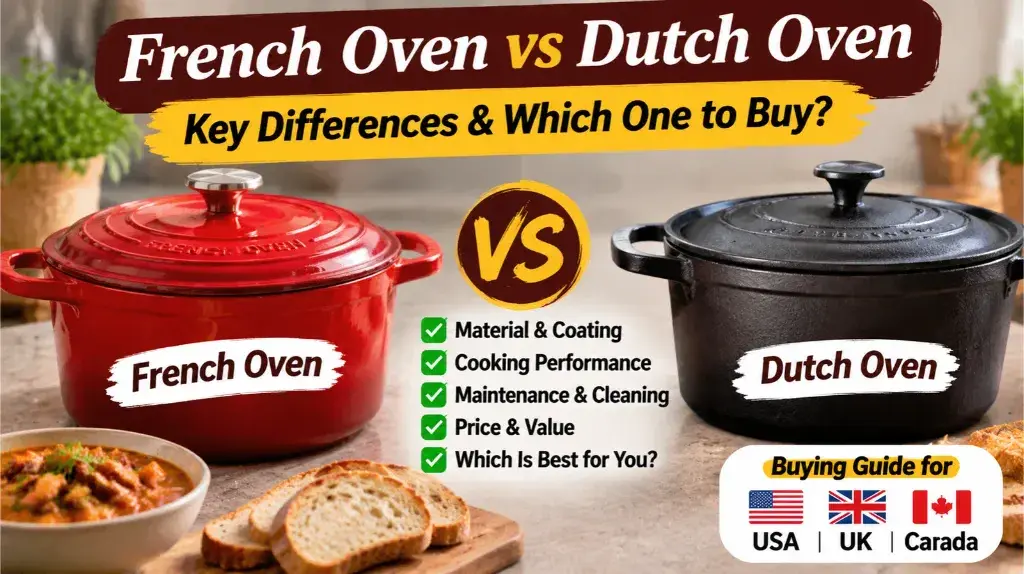
If you have ever shopped for heavy-duty cookware, you have probably come across two familiar names: French oven and Dutch oven. At first glance, they look almost identical. Both have thick walls, heavy lids, and a reputation for making delicious slow-cooked meals.
But are they actually different?
The short answer is that a French oven is generally an enameled cast iron version of a Dutch oven. However, modern cookware brands sometimes use these names interchangeably, which makes shopping a little confusing.
The real difference is not simply the name printed on the box. It comes down to the cooking surface, maintenance, material, and design.
In this guide, we will compare French ovens and Dutch ovens in detail. You will learn how they differ, what each one does best, how much maintenance they require, and which option makes more sense for your kitchen.
Whether you are shopping on Amazon in the USA, UK, or Canada, this comparison will help you make a smarter buying decision.
Quick Answer: French Oven vs Dutch Oven
A French oven is generally an enameled cast iron Dutch oven, while the broader term Dutch oven can refer to both bare cast iron and enameled cast iron cookware.
- French Oven: Usually features an enameled cast iron cooking surface. It does not require seasoning and is relatively easy to clean.
- Traditional Dutch Oven: Often made from bare cast iron. It needs seasoning and proper drying to prevent rust.
- Enameled Dutch Oven: Combines the heavy construction of cast iron with a protective enamel coating.
Both can be excellent for soups, stews, braised meat, casseroles, and homemade bread.
Our recommendation: If you want easy maintenance and everyday versatility, choose an enameled cast iron model. If you enjoy traditional cast iron cooking, outdoor cooking, or want a more affordable option, bare cast iron may be a better fit.
What Is a French Oven?
A French oven is a heavy cooking pot typically made from cast iron with an enamel coating.
It usually features thick walls, a tight-fitting lid, and sturdy side handles. The enamel coating creates a smooth cooking surface and protects the underlying cast iron.
French ovens are particularly popular for slow cooking, braising, simmering, and baking.
One reason people like them is their combination of traditional cast iron performance and relatively easy maintenance.
Unlike bare cast iron, an enameled French oven does not need regular seasoning. You can cook tomato-based sauces, soups, and other acidic dishes without worrying about the same seasoning concerns associated with bare cast iron.
Popular French cookware brands include Le Creuset and Staub.
These pots are available in different sizes, colours, shapes, and interior finishes.
Common Uses of a French Oven
- Preparing beef stew and chicken soup
- Slow-cooking meat and vegetables
- Braising short ribs and lamb
- Making tomato-based sauces
- Baking sourdough bread
- Preparing casseroles
- Simmering homemade stock
Its heavy construction helps maintain steady heat, while the lid helps retain moisture during covered cooking.
What Is a Dutch Oven?
A Dutch oven is a thick-walled cooking pot with a heavy, close-fitting lid.
Traditional Dutch ovens were commonly made from bare cast iron. Modern versions are also available with enamel coatings.
The traditional design has been used for generations because cast iron holds heat well and can handle a wide range of cooking methods.
Dutch ovens are popular in both home kitchens and outdoor cooking environments.
A bare cast iron Dutch oven can be used on a stovetop, in an oven, or over a suitable outdoor heat source, depending on its construction.
Enameled Dutch ovens are more commonly designed for indoor kitchen use.
Common Uses of a Dutch Oven
- Cooking soups and stews
- Making homemade chili
- Braising beef and chicken
- Baking crusty bread
- Deep-frying food
- Preparing one-pot meals
- Cooking outdoors over suitable heat sources
One of their biggest advantages is versatility. However, the care requirements depend on whether the pot is bare cast iron or enameled.
French Oven vs Dutch Oven: 7 Key Differences
1. Material and Construction
The most important distinction is usually the cooking surface.
A French oven is typically made from cast iron with an enamel coating. A traditional Dutch oven may use bare cast iron without an enamel layer.
Both retain heat effectively because of their heavy cast iron construction.
However, the enamel coating changes how you care for and use the cookware.
Bare cast iron has a seasoned cooking surface that needs regular maintenance. Enameled cast iron has a smooth protective coating that makes everyday cleaning easier.
Keep in mind that not every Dutch oven is made from bare cast iron. Many modern Dutch ovens are enameled, too.
2. Cooking Performance
Both types can perform very well in the kitchen.
Cast iron heats more slowly than some lighter cookware materials, but it holds heat effectively once properly preheated.
This makes it useful for recipes that require steady temperatures over longer cooking periods.
French ovens and Dutch ovens can both handle:
- Slow cooking
- Braising
- Simmering
- Roasting
- Baking
- Searing
When comparing two pots with similar cast iron construction, the difference in cooking performance may be very small.
The shape, dimensions, thickness, lid fit, and cooking technique can matter more than the product name.
3. Cleaning and Maintenance
This is where many buyers notice a practical difference.
An enameled French oven is generally easier to maintain because it does not require seasoning.
You can wash it with warm water, mild dish soap, and a soft sponge after it cools.
A bare cast iron Dutch oven requires more attention.
You need to maintain its seasoning, avoid leaving it wet, and dry it thoroughly after washing to prevent rust.
For busy home cooks, enameled cookware is often the more convenient option.
However, enamel is not indestructible. It can chip or crack if the pot is dropped, struck against a hard surface, or exposed to sudden temperature changes.
4. Durability and Lifespan
Both types can last for many years when properly cared for.
Bare cast iron is particularly durable because it does not have an enamel layer that can chip. Even if its seasoning becomes damaged, you can generally restore the cooking surface through proper cleaning and reseasoning.
Enameled cast iron has a different advantage. Its coating protects the underlying iron from direct exposure to food and moisture. However, the enamel can be damaged by impacts, thermal shock, or improper cleaning.
Neither option is automatically more durable in every situation.
5. Price and Value
Traditional bare cast iron Dutch ovens are often available at more affordable prices than premium enameled cookware.
Enameled French ovens can cost considerably more, particularly when they come from established premium brands.
Price depends on brand reputation, manufacturing quality, size, enamel finish, lid construction, warranty coverage, and retailer.
A premium French oven can be a worthwhile long-term purchase if you cook regularly and value its finish and convenience. But you do not necessarily need an expensive French oven to prepare excellent meals.
6. Appearance and Design
French ovens are often available in attractive colours, including red, blue, cream, and green.
Traditional bare cast iron Dutch ovens usually have a more basic dark metal appearance. Enameled Dutch ovens, however, can look very similar to French ovens.
Therefore, appearance alone is not a reliable way to identify the cookware category.
7. Cooking with Acidic Ingredients
Bare cast iron can react with acidic ingredients, especially during prolonged cooking.
Tomatoes, vinegar, wine, and citrus-based ingredients may affect the seasoning and can sometimes produce a metallic taste.
Enameled cast iron provides a protective cooking surface that makes it more suitable for these recipes.
That is one reason French ovens are popular for tomato-based pasta sauces, beef bourguignon, vegetable stews, wine-based braised meat, and homemade tomato soup.
French Oven vs Dutch Oven: Comparison Table
| Feature | French Oven | Traditional Bare Dutch Oven |
|---|---|---|
| Main material | Enameled cast iron | Bare cast iron |
| Enamel coating | Usually yes | No |
| Seasoning required | No | Yes |
| Heat retention | Excellent | Excellent |
| Cleaning | Relatively easy | Requires more care |
| Rust protection | Enamel protects the cooking surface | Requires proper seasoning and drying |
| Acidic foods | Generally suitable | Requires more caution |
| Outdoor cooking | Depends on model and instructions | Often suitable |
| Appearance | Often colourful | Usually dark metal |
| Price | Often higher | Often more affordable |
| Maintenance | Relatively simple | More involved |
Important: This table compares the typical French oven with a traditional bare cast iron Dutch oven. An enameled Dutch oven can have almost identical features to a French oven.
French Oven vs Enameled Dutch Oven: Are They Different?
Many shoppers assume that a French oven and an enameled Dutch oven are two separate types of cookware.
In most cases, they are essentially the same category of product.
Both generally feature cast iron construction, protective enamel coating, heavy lids, strong heat retention, a smooth cooking surface, and no seasoning requirement.
The difference often comes from branding and the terminology used by manufacturers.
Le Creuset, for example, explains that French ovens are also known as Dutch ovens or cocottes.
So, if you find two products with the same material, size, and construction, do not assume the one called a French oven will automatically cook better.
Compare the actual specifications instead.
Which One Is Better for Different Cooking Styles?
Best for Everyday Family Cooking: French Oven
If you prepare meals regularly for your family, an enameled French oven can be a convenient choice. You can use it for soups, stews, casseroles, sauces, and braised dishes.
Best for Outdoor Cooking: Bare Cast Iron Dutch Oven
If you enjoy camping or outdoor cooking, traditional bare cast iron may be a better option. Some outdoor Dutch ovens are specifically designed with legs and flanged lids. Choose a model intended for outdoor use.
Best for Sourdough Bread: Either Type
Both enameled and bare cast iron Dutch ovens can be used for sourdough bread. Their heavy construction helps maintain heat, while the covered environment helps retain steam during the early baking stage.
Check the maximum oven temperature, lid-knob rating, and manufacturer’s instructions.
Best for Tomato-Based Recipes: French Oven
Enameled cast iron is generally more suitable for acidic ingredients. If you frequently cook tomato sauces, wine-based dishes, or acidic stews, it is a convenient choice.
Best for Budget Buyers: Bare Cast Iron Dutch Oven
If your main concern is price, traditional bare cast iron is worth considering. It can provide excellent cooking performance without the added cost of decorative enamel finishes.
What Size Should You Buy?
| Capacity | Best For |
|---|---|
| 2–3 quarts | One or two people |
| 4–5 quarts | Couples and small families |
| 5.5–6 quarts | Most households |
| 7–8 quarts | Larger families and batch cooking |
| 9+ quarts | Entertaining and large meals |
For many households, a 5.5- to 6-quart model is a sensible starting point. If you frequently cook large portions or prepare meals for guests, consider a larger option.
What Are the Best Brands to Consider?
1. Le Creuset
Le Creuset is a well-known French cookware brand associated with premium enameled cast iron. Its Dutch ovens are popular for their colourful finishes, light-coloured interiors, and versatile designs.Check Le Creuset on Amazon
2. Staub
Staub is another established French cookware brand. Its cast iron cocottes are known for their dark interiors and distinctive lid designs.Check Staub on Amazon
3. Lodge
Lodge is a popular American cookware brand offering both bare cast iron and enameled cast iron products. It is worth comparing if you want practical cookware at a more accessible price.Check Lodge on Amazon
4. Cuisinart
Cuisinart offers several cookware collections, including enameled cast iron Dutch ovens. Before buying, check the exact model, capacity, oven-safe temperature, and warranty.Check Cuisinart on Amazon
How to Choose Between a French Oven and a Dutch Oven
1. Do You Want Easy Maintenance?
Choose enameled cast iron if you prefer cookware that does not require seasoning.
2. Do You Cook Acidic Foods Regularly?
An enameled model is generally more convenient for tomato sauces, wine-based recipes, and acidic dishes.
3. Do You Enjoy Outdoor Cooking?
A traditional bare cast iron Dutch oven may be a better option if it is specifically designed for outdoor use.
4. What Is Your Budget?
Compare both premium and budget-friendly options. You do not have to spend a large amount to get useful cast iron cookware.
5. How Much Food Do You Usually Prepare?
Choose a capacity that matches your household size and cooking habits.
Where to Buy French Ovens and Dutch Ovens
Once you know which type suits your cooking style, the next step is finding the right model.
Amazon is a convenient place to compare cookware because you can review different brands, sizes, colours, specifications, and customer feedback.
Shop from Your Local Amazon Store
Shopping for a French oven or Dutch oven from the USA, UK, or Canada? You can use the Amazon product links throughout this guide to check available options in your region.
With Amazon OneLink enabled, eligible visitors may be redirected to their local Amazon storefront when they click an affiliate link. This makes it easier to browse local product listings, check regional pricing, and find available delivery options.
Please note that product availability, prices, shipping options, and discounts may vary by country. Always check the final product details on Amazon before placing your order.
Buying in the USA
US shoppers can compare products on Amazon.com. Look at the total price, delivery options, return conditions, and manufacturer warranty.
Buying in the UK
UK shoppers can use Amazon.co.uk to compare local product availability and pricing. Check capacity in both quarts and litres, as well as oven temperature specifications.
Buying in Canada
Canadian shoppers can compare available options on Amazon.ca. Remember to check the final price in Canadian dollars, delivery charges, and warranty coverage.
Before You Buy
- Exact product model
- Cast iron or enameled construction
- Capacity and dimensions
- Maximum oven temperature
- Lid and knob material
- Induction compatibility
- Customer reviews
- Warranty and return policy
A little research before purchasing can help you avoid choosing the wrong product.
Frequently Asked Questions About French Oven vs Dutch Oven
1. Is a French oven the same as a Dutch oven?
A French oven is generally an enameled cast iron version of a Dutch oven. However, modern manufacturers sometimes use the names interchangeably. The actual material and construction matter more than the name.
2. Which is better, a French oven or a Dutch oven?
Neither is universally better. A French oven is convenient for everyday cooking and easy maintenance. A traditional bare cast iron Dutch oven is useful for outdoor cooking and people who prefer seasoned cookware.
3. Can you use a French oven instead of a Dutch oven?
Yes. An enameled French oven can handle most recipes that call for a Dutch oven, including soups, stews, braising, and bread baking. Always check the cookware’s temperature and use instructions.
4. Does a French oven need seasoning?
No. Enameled cast iron French ovens do not require seasoning. Their enamel coating provides a protective cooking surface.
5. Does a Dutch oven need seasoning?
It depends on the material. Bare cast iron Dutch ovens need seasoning, while enameled Dutch ovens do not require seasoning on their enamel cooking surface.
6. Can you cook tomato sauce in a Dutch oven?
Yes, if it is enameled cast iron. For bare cast iron, prolonged cooking with acidic ingredients can affect the seasoning and may produce a metallic taste.
7. Is a French oven good for sourdough bread?
Yes. Many French ovens are suitable for sourdough bread baking. Their heavy construction helps retain heat and steam. Check the manufacturer’s maximum temperature rating before use.
8. Why are Le Creuset French ovens so expensive?
Le Creuset cookware is positioned in the premium market. Its price reflects factors such as manufacturing, enamel finishing, design, quality control, and brand reputation.
9. Can you use a Dutch oven on an induction cooktop?
Most cast iron Dutch ovens are compatible with induction cooktops because cast iron is magnetic. However, always check the manufacturer’s specifications for the exact product.
10. Is an enameled Dutch oven worth buying?
For many home cooks, yes. It combines cast iron heat retention with easier maintenance. It is particularly useful for soups, stews, braising, and acidic recipes.
11. What is the difference between a French oven and a cocotte?
Cocotte is a French term commonly used for enameled cast iron cookware. It often refers to the same general type of pot sold as a French oven or Dutch oven.
12. What size Dutch oven is best for a family of four?
A 5.5- to 6-quart Dutch oven is a good starting point for many families of four. Choose a larger model if you regularly cook large meals or prepare food in batches.
Final Verdict: French Oven vs Dutch Oven
So, which one should you choose?
The answer is simpler than it first appears.
A French oven is generally an enameled cast iron Dutch oven. Both offer excellent versatility, heat retention, and the ability to prepare a wide range of meals.
The biggest practical difference is whether the cookware has an enamel coating.
If you want easier cleaning, no seasoning requirements, and a convenient option for acidic recipes, an enameled French oven is an excellent choice.
If you prefer traditional cast iron, want to cook outdoors, or are looking for a more affordable option, a bare cast iron Dutch oven may suit you better.
For most everyday home cooks, an enameled cast iron model in the 5.5- to 6-quart range is a practical investment.
Before buying, compare the material, capacity, construction, and warranty rather than focusing only on the product name.
The best cookware is not necessarily the most expensive one. It is the one that fits your cooking habits and makes preparing meals easier.
Disclosure: As an Amazon Associate, I may earn from qualifying purchases at no extra cost to you. Amazon and the Amazon logo are trademarks of Amazon.com, Inc, or its affiliates.
